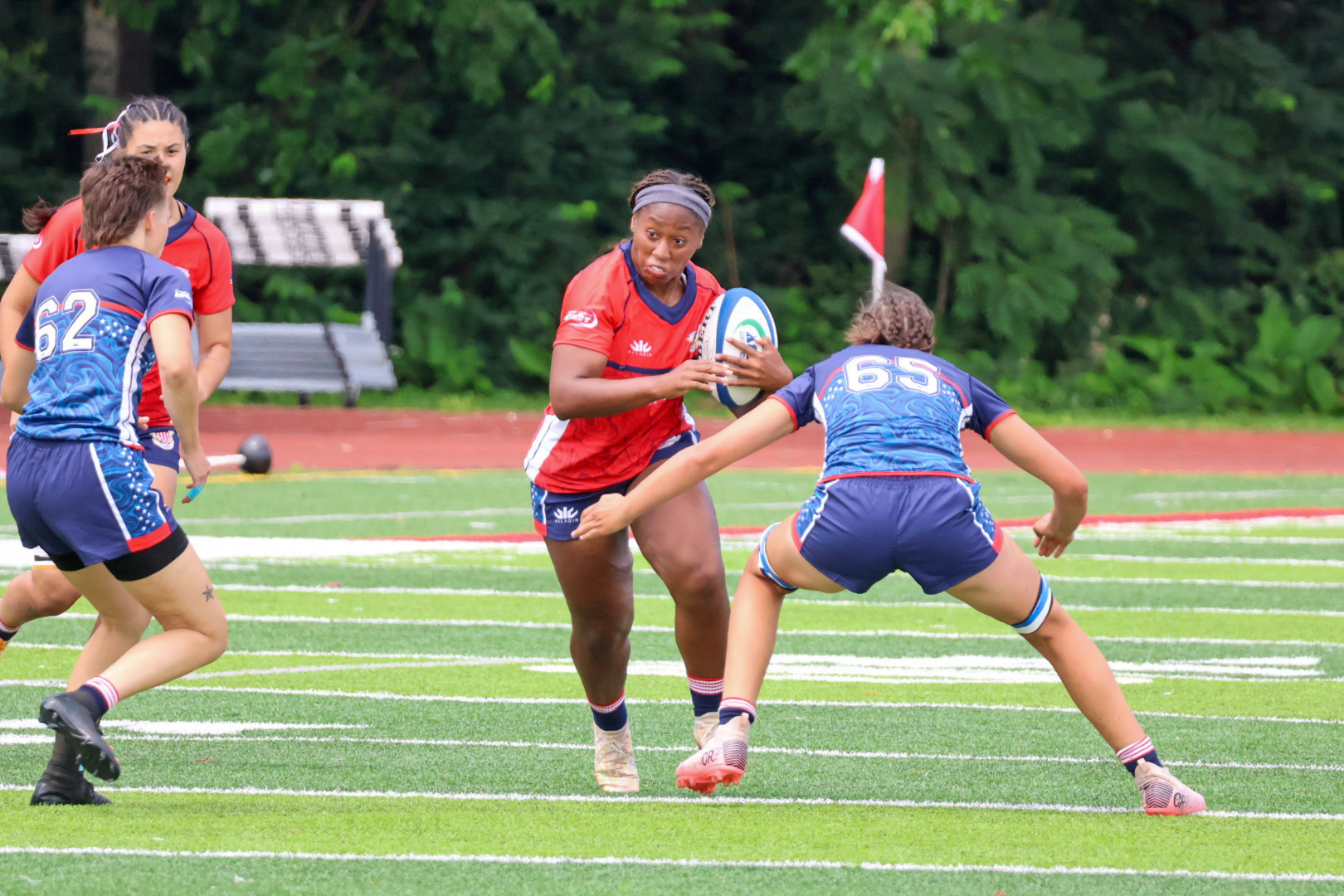
Unstoppable force met immoveable object on Saturday, July 11, as 40 of the top collegiate women’s rugby players in the country divided themselves into two teams and duked it out for bragging rights at Benedictine University Stadium in Lisle, IL.
Things started off with a bang for the Red team, led by legendary Canadian international Magali Harvey, as their opponents had difficulty corralling the opening kickoff by Southern Nazarene’s Ireland Jeffrey. The bouncing ball eventually found its way into the arms of Northeastern’s Mira Mahmoud, who bullied her way over the line to put Red up 5-0 within the first 20 seconds of the match.
Jeffrey’s conversion made it 7-0, and the score remained that way for much of the first half. Neither offense was able to find a consistent rhythm, with passess bouncing off finger tips and support arriving just a step too late on many occasions – growing pains that one might expect to see from a team that has had less than a full week to try and find some sort of cohesion.
Both teams did play terrifying defense, however, firing off their lines, bulldozing their opponents in counterrucks, and creating more dominant tackles than Portia Woodman-Wickliffe. The Red team had the most chances, though, since they dominated possession throughout the first half. They seemed content to let players like Olivia George (Wisconsin Eau-Claire) and Keyonna Wilson-Rhodie (NC State) feast on hard-earned meters in the middle of the pitch to try and give the backs some front-foot ball.
But the Blue team, skippered by American international and Princeton head coach Karameli Fa’ae’e, always seemed to find an answer around their own goal line, producing several key turnovers inside their own 22 to hold the deficit to one score.
The dam broke right around the 40-minute mark after some hard running and a beautiful combination of passes between Sierra Gallup (Colorado State), Tara Bogansky (East Stroudsburg) and Natalie Lamar (St. Bonaventure) put Mahmoud away for her second try of the match. This two-score lead, plus their stranglehold on possession for much of the first half, made a Red victory seem inevitable. But Blue had plenty of superstars as well, and none of them were ready to throw in the towel.
Blue came out on fire in the second half, led by Colorado’s Lucia “Sauce” Hoffman, and completely swung the momentum. The scrum and the lineout had been the only issue for the Red team in the first half, and both set pieces would come back to bite them in the second. About five minutes in, Hoffman leapt into the air to snag an errant throw from George in a lineout inside the Red 22 and bulldozed three defenders to score her team’s first points of the match. The referee initially ruled that the ball had been held up in the try zone, but the call was eventually overturned, bringing the Blue team back within one score.
A scrum penalty called on Red about 20 minutes later allowed Blue to pull within two points after a strong run by the University of Iowa’s Gillian McRae led to a try by Wisconsin Eau Claire’s Maggie Kane.
Smelling blood in the water, Blue scored their third unanswered try a few minutes later. After a series of pick-and-go’s around the goal line, New Hampshire sophomore Sarah White dotted down for the go-ahead score. Madison “Corn” Cornell of Eau Claire converted to make it 17-12, Blue, with about ten minutes left on the game clock.
Some nifty back-and-forth offloading between Red’s Northeastern’s Kourtney Bichotte-Dunner and Arizona State’s Lily Morrison – who had both been electric in open space all afternoon and who had both gotten banged up at some point earlier in the match – led to a last second try for Bichotte-Dunner that knotted the game at 17-17. As the final seconds ticked off the game clock, Jeffrey’s conversion attempt from a tough angle sailed just left ending the match in a draw.
Despite neither team emerging victorious as a whole, Women’s Commissioner Alycia Washington is confident that the camp was a win overall for the individual players in attendance, all of whom were nominated by selectors or their coaches because they felt they had what it takes to represent the country at the All-American level.
“It’s just really important to us to have these sort of camps to prepare the players for whatever comes next in their careers,” Washington explained. “They get exposure to high-level coaching, different styles of play, and working with different teammates. They just experience a diversity of learning in this environment that they can also then bring back to their home clubs.”


.png)
